
Phenix City Address History Records
The era decides where an address search starts. A modern Russell County transfer may be online. An older deed needs a physical index. A named occupant in the early or mid-twentieth century may appear in a regional directory, while a released census can show a fuller household. None of these sources has complete local coverage, so the year ranges below are verified holdings or access limits rather than a claim that every address appears.
| Source | Years It Covers | Where Held | What It Shows |
|---|---|---|---|
| Russell online real estate | June 2002 to present | Russell County Probate link | Recorded ownership chain |
| Earlier county deeds | Before June 2002 in Russell; Lee cutoff not verified | Probate office indexes and books | Parties, legal description, and book-page trail |
| Digitized R.L. Polk directories | Verified volumes from 1921 through 1960, with gaps | DLG and Columbus Public Library | Printed occupant, spouse, address, and dated work detail |
| ADAH directory holdings | Dense 1941 through 2002 run, with listed gaps | ADAH boxes and research service | Year-by-year name and address leads |
| Federal census | Released through 1950 under the 72-year rule | NARA and library databases | Household on the census date |
| Planning and abatement files | Contemporary dated files; no archive cutoff verified | Phenix City agenda files or request | Parcel, assessed owner, zoning, condition, or deed clue |
Start with the source nearest the target year, then bridge to a second source. The two timelines should agree on the address, the land, or a closely dated identity clue before a person is placed in the Phenix City chain.
Start Phenix City Resident Trail
Normalize the present address through USPS and a city or county boundary source. A Phenix City mailing line can lead to Russell or Lee County, and that choice controls the tax card, GIS map, and deed office. Copy the parcel ID, situs address, assessed owner, owner-mail destination, legal description, subdivision or lot-block text, and deed references only when the live card shows them. Note the tax year.
Lee tax notices can show ownership as of October 1 of the prior year, and an “in care of” entry may reflect a former owner. Russell property tools are dynamic, with some live fields still unverified in the research. In both counties, the situs is the physical parcel and the mail address is a correspondence destination. Neither one proves a whole past household.
The present card establishes land identity. It is the launch point for previous residents, not the answer.
Trace Phenix City Resident Deeds
A backward deed chain follows recorded ownership while holding the land constant. Street names and numbers can change. A legal description is often more durable. Russell County's June 2002 online threshold also means that a single web search cannot carry an old Phenix City parcel through its full history.
- Find the current acquisition deed from the assessed owner and the parcel's displayed deed clue.
- Record the grantor, grantee, execution and recording dates, instrument or book-page reference, legal description, and prior reference when shown.
- Search the seller, who is the grantor in that transfer, as a grantee in an earlier acquisition.
- Match the land description, co-owner, and prior reference. Do not join records by name alone.
- For Russell records before June 2002, move to Probate's counter indexes and deed books. For Lee records, use the courthouse viewing stations or staff-assisted lookup.
- Grantor
- The person or entity transferring an interest in land.
- Grantee
- The person or entity receiving that interest.
- Chain of title
- The linked sequence of recorded land transfers.
- Legal description
- The deed's formal land text, which can survive a street renaming or renumbering.
- Return address
- A destination used for a recorded document. It is not automatic proof of residence.
Keep a deed log with one row per transfer. A break stays open until the prior party and the same land are both confirmed.
Phenix City Probate Records Split
The Russell County Judge of Probate links real-estate records from June 2002 forward and keeps deeds, mortgages, plats, estates, marriage records, licenses, and notary material. Earlier Russell work requires the office indexes and deed books. Current pages list transactions at 1000 Broad Street, while another official directory lists 501 14th Street, so call 334-298-7979 before a visit.
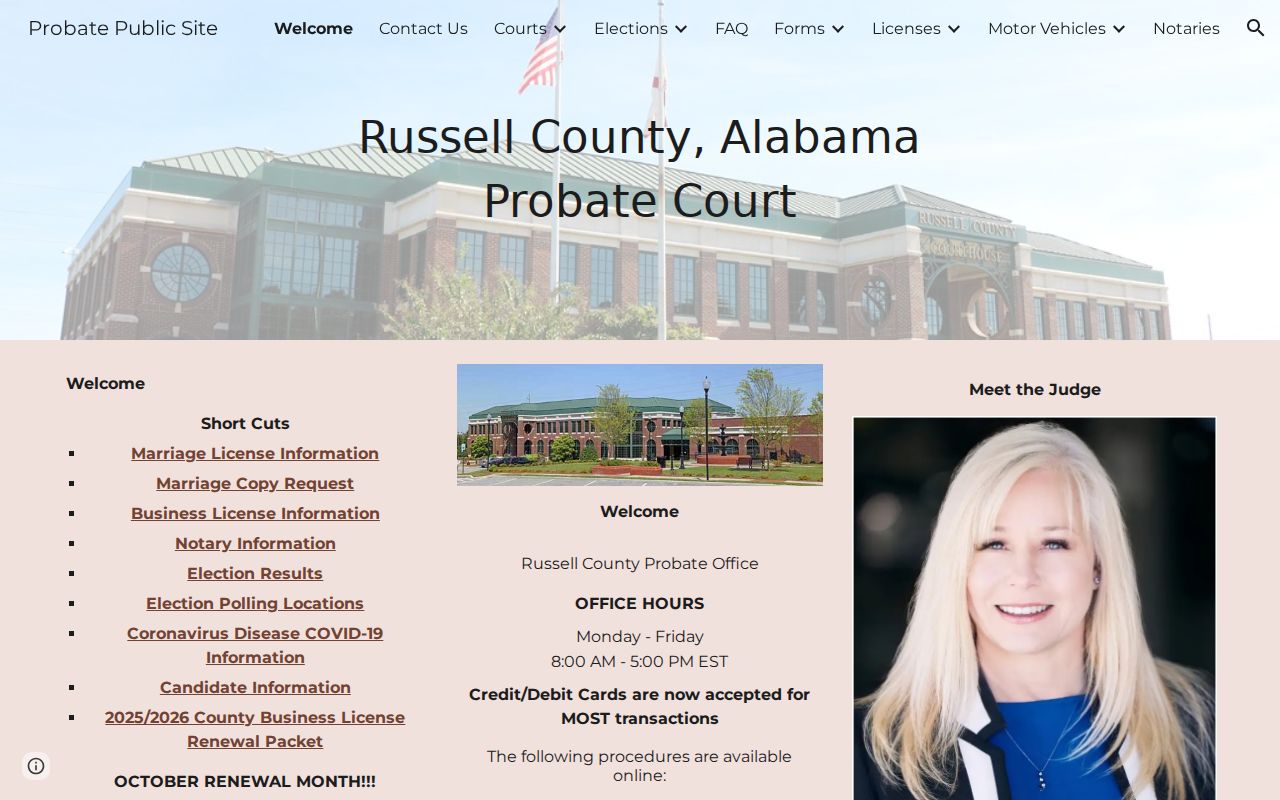
The office page is the bridge from a current Russell parcel to recorded transfers and, when a life trail ends, an estate file.
Lee County Probate is at 215 South 9th Street in Opelika. Its official guide directs researchers to courthouse public-viewing stations and says staff can assist with a name lookup. Mail or counter copies are easier when book, page, and recording date are known. The listed rate is $1 per page plus $3 certification per document. No official online cutoff was found for Lee, so begin with the counter route rather than assuming a searchable web run.
Match Phenix City Past Residents
Owners are one line. Occupants are another. Search a person's name in a directory's alphabetical pages and OCR, then record spouse, printed work detail, address, householder or resident symbol, source page, and year. Inspect a street section when the volume truly has one. Repeat in nearby years. A disappearance or new household is a lead, not proof of a move or death.
Pair the 1928 directory with the 1930 census, the 1939 through 1942 volumes with the 1940 census, and the 1949 through 1950 volumes with the 1950 census. Compare names, ages, family ties, neighbors, cross streets, and the exact address. The federal census is released under a 72-year rule and captures one census date; the directory is publisher data that may omit, retain, or simplify entries. Agreement between the two is stronger than either alone.
The detailed volume runs and reading method are covered in the Phenix City directory book. For previous residents, extract only what advances the one-address timeline.
Practical access. Phenix City library-card patrons can use Ancestry inside the local library, while CVL and ADAH add regional and state collections.
Phenix City Directory Time Bridge
Digitized R.L. Polk joint volumes are verified for 1921, 1923, 1928, 1939 through 1942, 1945 through 1947, 1949 through 1950, 1955, and 1960. The Alabama Department of Archives and History finding aid lists Phenix City and joint Phenix City-Columbus volumes across 1941 through 2002. Its stated gaps include 1948, 1956, 1970, 1973, 1988, 1990 through 1997, and years after 2002. A shelf gap does not prove that no copy exists elsewhere.
For a remote ADAH request, provide collection LPR104, the box, place-title, and year. Boxes 165 through 170 carry much of the 1941 through 1974 joint and local run; Box 171 states 1975 through 1987. Later cited holdings include 1989, 1998, 1999, 2000 through 2001, and 2002 in Boxes 200, 129, 211, and 231. ADAH staff searches no more than four sources per request, so a precise request matters.
DLG offers free page images and uncorrected machine text. Search a rare surname, spouse, street fragment, and name stem, then verify every hit on the page image. Narrow columns can confuse initials, digits, punctuation, and the short `h` or `r` codes.
Old Phenix City Directory Names
Who lived here before may be indexed under another place even when the land did not move. Present Phenix City grew from Girard and Brownville. Brownville's post office used Lively from 1871, and its rail depot used Knight's Station. The city took the Phenix City name in 1897, merged with Girard in 1923, and passed through county-boundary changes that were not final until 1932. Older directory and archive labels include Girard, South Girard, Columbus, and joint regional titles.
A Columbus-titled volume can still list an Alabama household. The 1928 OCR proves that point, and the 1950 title explicitly includes Phenix City and South Girard. Search the volume before rejecting it by cover. Cross-river ties drew Phenix City residents into Georgia-held publications and Columbus Public Library collections.
Parenthetical old and new street numbers are just as important. Preserve both numbers, then bridge them with neighbors, cross streets, plats, maps, and the deed's legal description. Treat two printed numbers as a clue, not as two separate past households.
Phenix City Resident Boundary Clues
Russell County began in 1832, and its seats moved from Girard to Crawford, Seale, dual Seale and Phenix City, and finally Phenix City alone in 1934. Older county books may follow those seats. The present incorporated city again spans Russell and Lee, so an address history can change its county heading across time or fall under a neighboring county today.
Sydney Smith papers preserve maps tied to the 1932 through 1933 boundary change. They can explain why an ancestor or parcel takes a new county label without a physical move. Use those maps as context, then prove continuity with the lot, block, legal description, nearby parcels, and deed references. County captions alone are not enough.
Historic districts such as Smith Residential, Snow Valley, and Upper 20th Street can help set a construction era or map cluster. They do not identify a current or former resident by themselves.
Close Phenix City Resident Gaps
When a named person vanishes from the address timeline, search nearby directory years, a spouse, an obituary, and the correct county Probate office. An estate file may name heirs or show the land passing after death, subject to sealing and privacy rules. Russell wills cost $1 per page with $3 certification in the researched office schedule. A will should be probated within five years of death.
The Phenix City Clerk genealogy service holds burial names and plat books for Girard and Pine Grove Cemeteries. Cemetery placement can link a dated family lead to a burial site, but it is not a certified death record. Confirm with an obituary, marker, probate file, or eligible Alabama death certificate. The clerk can also supply current and archival city documents through a focused records request.
Russell court files may add a dated legal event when the name and case are already known. The Russell court record request page documents both the lobby terminal and copy route.
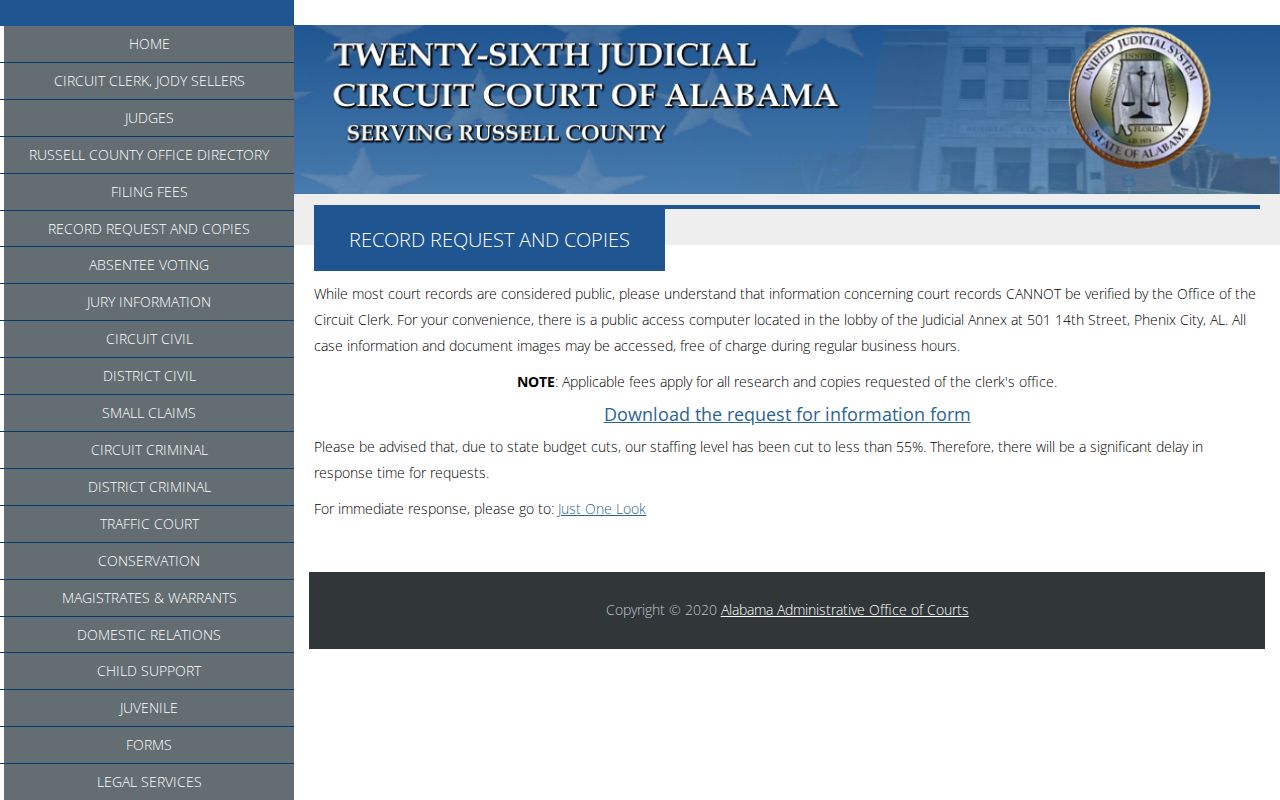
The free lobby terminal can supply available case information and images during office hours; it should support, not replace, the deed and directory trail.
Phenix City Resident Evidence Gaps
No verified searchable municipal permit archive or cutoff was found. Request a precise Phenix City address, record type, and year range from the City Clerk or Building staff. A permit can date work or name an applicant, but it does not prove who occupied the site. An abatement file names the person or entity last assessed for tax and records a dated condition, not a full household.
A 1922 Phenix City Sanborn item surfaced in a secondary catalog, but no direct Library of Congress item page was verified. Do not claim local edition years, sheets, or online access until the official catalog record is resolved. Likewise, exact local reverse-directory years were not established. Ask Phenix City-Russell County Library, Columbus Public Library's Genealogy and Local History Department, or ADAH whether a specific year contains a street section.
Note: A missing online hit may point to paper, microfilm, protected, sealed, or differently indexed material rather than a true break in residence.
Use Phenix City Records Lawfully
A past address can involve people who are still alive. Alabama protects some voter addresses, protection-order fields, Social Security numbers, birth dates, and other personal data. Never publish a protected address found in an old copy. Keep research notes tied to source dates, and correct a record through the office that owns it rather than treating a commercial compilation as final.
Previous residents research fits family history, land history, heir questions, and personal curiosity. It does not justify unwanted contact. Alabama stalking and harassment laws apply to electronic, written, mail, phone, and anonymous conduct described by those statutes.
Lawful personal use. Never use Phenix City address history to track, threaten, stalk, harass, or expose any living person.